Tuesday, August 3, 2010

Mount Vernon, Monticello and Slavery

There is much in the news these days about how we have strayed too far from the principles laid down by the Founding Fathers. Tea Party activists promote the actions and beliefs of those who broke with Britain over two hundred years ago. And even the Supreme Court seems dominated by those who adhere to the original intent of the framers and see the Constitution not as a living document but as a closed text. In uncertain times the past can provide a certain comfort, a soft landing spot where verities are always eternal. A closer look at the past reveals a more complex picture.

I visited Mount Vernon this summer. A summer ago I went to Monticello. Both places welcome and inform the public. Mount Vernon is the home of the first President George Washington and Monticello is the estate of the third President, Thomas Jefferson. They tell us a great deal about life in colonial America and the early Republic. Both places also gave me unexpected insights into the lives of the wealthy landed colonials who played such a large part in the invention of the USA. For me, an immigrant from Europe, the most striking feature shared by both estates, is the central role of slave labor. The slave contribution is visible, everywhere and obvious. This is not the distant transfer of wealth from sugar plantations in the Caribbean to English Georgian mansions—an indirectness that separates the conspicuous consumption from its bloody base. This is the direct, everyday, cheek-by-jowl exploitation of people sharing the same space, breathing the same air and living on the same estate. It is the intimacy of the slavery that is so striking. What makes both places so shocking is the closeness of the master-slave relationship. It is the direct exploitation of your living neighbors. For someone who grew up in Europe, slavery was always distant and foreign. In the early US it was part of the domestic ecology.
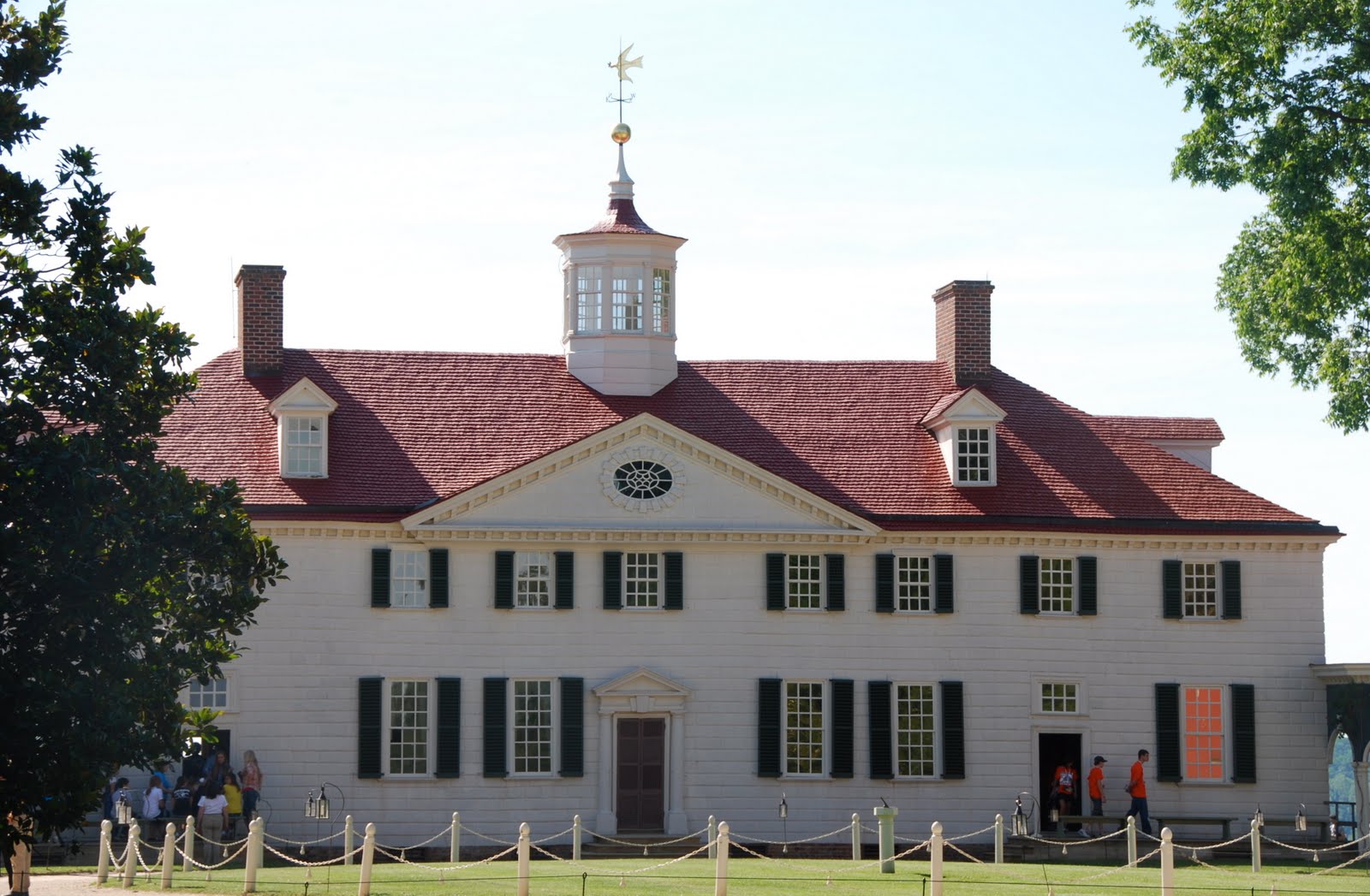

Mount Vernon: The Big House

Washington inherited 10 slaves when he was eleven years of age. At the time of his death in 1799 there were 316 slaves living in Mount Vernon. Food was grown by slaves, they tilled the land, mowed the hay, tended the animals. From sunrise to sunset they labored to keep George and Martha fed and clothed. The hospitality and quiet dignity that most visitors commented upon was founded on the backbreaking relentless toil of humans in permanent bondage.


Mount Vernon: Slave Cabin


Jefferson was owner of over 600 slaves. He lived in a beautiful Neo-Palladian mansion of his own design while hundreds of slaves resided in cramped accommodation unable to leave the estate of the man who wrote the Declaration of Independence.


Monticello


Were they just hypocrites? Mouthing freedoms while they lived off the unpaid labor of others. “How is it”, remarked the Englishman Samuel Johnson, “that we hear the loudest yelps for liberty among the drivers of negroes”? In their defense, they were people of their times, thrown into a slave-owning society unable to change things around them. Yet the same people resisted the political status quo and fought the greatest imperial power in a long struggle for independence.

Slavery was maintained by acts of racial terrorism. Slavery and its long drawn out, trailing and entangling consequences have permanently marked and scarred the reality and the promise of the US. To enslave fellow humans while mouthing the rights of man was an act of hypocrisy that damaged the moral base of the country. We have yet to fully recover. We are not helped by willful acts of historical amnesia. Part of the recovery requires a more honest assessment of the nation’s past than that promoted by today’s ideologues.

(All Photos © John Rennie Short)

Monday, June 7, 2010

Istanbul

To say that Istanbul is situated between East and West is not a trite cliché, but a simple statement of geographical reality. The city sprawls across the narrow sea passage between Europe and Asia.

Like all maritime cities—it fringes not only the Bosporus, but also the Golden Horn and the evocatively named Sea of Marmara—it has an expansive luminosity, a salt-tinged clarity and sea-breezed airiness. Even with 17 million people and busy traffic, it still manages to shine and sparkle.

The city straddles both continents and embodies the varied and long contacts between East and West. Founded in 330 by the Emperor Constantine as Constantinople, it became the capital of the Byzantine Empire that stretched throughout the Eastern Mediterranean, covering parts of Europe as well as Asia. As an important repository of the legacy of Greek classical thought and a transmission point for the intellectual flowering of Arabic and Persian scholarship, Constantinople stayed lit when Western Europe sank into the dark ages. The Byzantines kept the sparks of culture alive that subsequently caught fire in the Renaissance of Western Europe. There were also more destructive exchanges. The city was pillaged in the Fourth Crusade, its treasures looted and taken back to Western Europe. The churches of Venice are filled with the theft.

When it became the capital of the Ottomans, it was the centre of an empire that embraced the continents of Africa, Asia and Europe. At its furthest extent, the city’s power reached to the very gates of Venice. Under the longest reigning Sultan, Suleiman the Magnificent (r. 1520-1566), not only was the empire extended, but also the city was adorned with new mosques and multicultural tolerance was practiced. The city is still filled with the most beautiful of religious architecture including the intimate Church of St. Savior in Chora, the serene Hagia Sophia and the stunning Blue Mosque. The city skyline as it stretches across the hills is punctuated with minarets ands towers, Ottoman mosques and Byzantine churches.

Blue Mosque, Istanbul

The names Byzantine and Ottoman cover processes rather than fixed objects. The Byzantine Christians grafted their religion onto pagan roots, and their later art reflected contact with the East as well as encounters with the West. The icons produced in the later Byzantine Empire have a more naturalistic representation, reflecting contact with the art of the Western Renaissance. Constantinople/Istanbul was a city where Arabic and Turkish, as well as Greek and Italian, could be heard in the streets. As the Ottoman Empire waned, there was a growing admiration for an ascending West. In 1856, the Sultan abandoned the Topkapi Palace for a new Neoclassical palace at Dolmabahce, which could look just as at home on the banks of the Seine or the Thames as it does on the Bosporus. The encounters continue. Today the Grand Bazaar first founded when the Ottomans gained control of the city in 1453, is filled more by foreign tourists than native Turks.

Grand Bazaar

Istanbul is less a fixture and more an ongoing process, a crucible where East and West are reshaped. Turkey is a longstanding, vital member of NATO and continues to forge further links with the West. Its application to join the European Union is just one of many ventures reaching to the West. There is also a more recent religiosity that derives from the Islamic world. To walk the streets of Istanbul is to see women dressed in the most contemporary fashions as well as in the hijab. Islamic fundamentalism today is more an invented tradition of relatively recent vintage than a “pure” historical artifact. And a secular capitalist democracy is not an objective fixed in the future but part of an evolving present. The fundamentalist and the secular represent not the past and the future, respectively, but alternative conceptions of the present: Istanbul’s geographical reality stages these competing modernities in the form of tension between the comfort of an invented past and the attraction of an imagined future. Founded as a secular republic, modern Turkey is still situating between East and West, and at the heart of this unfolding drama is the city of Istanbul.


(All Photos: © John Rennie Short)

Thursday, March 25, 2010

Warsaw

I visited Warsaw for one week in mid-March. My first day there was wintry. On my last day it felt like spring, encouraging people to shed their heavy coats. Easy to see this experience as a metaphor for Poland’s recent history: the nation emerged from almost fifty years of Communist rule in 1989 as one of the first Eastern bloc countries to escape from the Russian grip. Poland embraced market reforms and joined the EU in 2004.

Warsaw’s Communist legacy is still evident. The Palace of Culture and Science (formerly Joseph Stalin Palace of Culture and Science) was the tallest building in Europe until 1957 and still dominates the skyline in the city center. An exuberant example of Soviet Realism, it was completed in 1955. There are also the blocks of former public housing, modernist monoliths scattered throughout Warsaw.


Polish Communism always had to deal with Polish nationalism. The old city reflects the commitment to rebuilding the city after the Nazis nearly annihilated it. Between the end of the Second World War and 1962, old town was carefully recreated from its ruins in an act of architectural memorialization that embodied Polish resilience and Polish identity. The many marvelous examples of Baroque and Neoclassical architecture remind us of Warsaw’s long connection with Europe.


The command economy still lives on in an unclear and uncertain land market. Large blocks of land lie undeveloped and undercapitalized, as investors are unsure of the property rights and legal claims. But there is also tremendous growth, especially at the edges of the city as the interstices between the modernist blocks are filled in with new housing and commerce and retail. One distinct feature is the number of gated communities. Guards and gates mark off many developments in both the central city and in the suburbs.

Like many post-Socialist cities, Warsaw has an infrastructure deficit, a huge housing shortage creating an overpriced housing market, a degraded urban environment in some places with feverish new investments in others. The city is still very Polish, one of the few examples of a European city that over the twentieth century saw it becoming more homogenous. Almost a half million Jews lived in this city prior to 1939. Now there is little more than 15,000. And yet to walk along Nowy Swiat is to see Starbucks and Subway, Colombian coffee houses and Indian restaurants. As I made my way up to the old town, I could see the local fashionistas sporting the ‘new black’ of purple scarves and coats. Cellphone usage is endemic and universal. Poland has such a poor landline network that consumers jumped more quickly to cellphone usage than in the USA. EU funding projects are ubiquitous throughout the city— refurbishing seventeenth-century palaces to providing school playgrounds.


In the city and the country as a whole there is realization that a post-Socialist city does not necessarily mean a neo-liberal city. Warsaw is in Mitteleuropa—situated between East and West Europe. It also occupies the difficult space between command and market economies, socialist and capitalist ideologies, authoritarian and democratic systems of government, of becoming as well as being.

(All Photos:© John Rennie Short)

Sunday, January 24, 2010

The Barack Administration One Year On

It is over a year since I witnessed and celebrated the inauguration of President Barack Obama. I was just one of millions who lined the Mall in the bright sunlight on a bitterly cold day. We were thankful that the US had elected a thoughtful and intelligent candidate, and we looked forward to a change after the debacle of the Bush presidency.

Alas, one year on and the greatest accomplishment of his administration is that he has returned major banks and giant financial institutions to profitability. Compared to the bright skies and high hopes of last January, this January is dark and gloomy. Health care reform is tantalizingly close but still unrealized and increasingly precarious. The war in Afghanistan escalates, Guantanamo Bay prison is still open and the Republicans have just won a stunning victory in Massachusetts.


Inauguration Day 2009
(Photo: John Rennie Short)

The financial intuitions were bailed out while much needed regulatory reform was slow to gain traction within the Administration. A number of poor choices were made. Geithner was a flawed candidate for Treasury Secretary from the very start. Apart from the issue of his failure to pay taxes—the result of either incompetence or sleaziness, neither of which is a desirable attribute of a cabinet officer—he was always too closely aligned with Wall Street. The New York Fed does not so much regulate Wall Street but shills for it. Geithner was head of the New York Fed before his appointment to Treasury. With a tin ear for popular sentiment, Obama also backed Bernanke for a second term as head of the Fed. The architects of the bailout, which most American saw as flawed and unfair, were rewarded. While stabilization was needed, it should have been paralleled with tough regulatory reform. Yet this reform was never vigorously promoted when it was most obviously needed—last March. Only in the last few days has Obama taken on the banks, belatedly shifting his reliance on advice from Geithner to Volcker. But in the wake of the obscene end-of-the-year bonuses on Wall Street and the dramatic Democratic defeat in the Massachusetts, Obama’s move looks craven and desperate. He should have done this more vigorously much earlier when he could have ridden and guided popular sentiment.

Health care reform has been botched totally. The legislation was never explained to the US public, allowing political enemies easy targets and lots of room for attack. Having to deny “death panels” is not the best way to sell health care reform. The sprawling legislation was never explained nor fully justified by Obama, who allowed the process to meander untended through the swamp that is the US Congress. The Democrats in the Senate took too long, wasted too much time waiting for the support of Senators Snowe and Collins that never materialized and was never going to materialize after the summer assault on the bill by the Republican base. The grubby backroom dealings as Democratic Senators sought to get free rides for their constituents, were shabby and odious and generated even more popular resentment. And while all this was happening, the White House stayed strangely silent.

Barack Obama is a thoughtful person and gifted orator, but on the basis of his first year I am sorry to conclude that he is an incompetent President. In only a year on from a historic victory, he has managed to revitalize and energize an embattled and dispirited Republican Party, alienate independents and deeply disappoint the Democratic base. When you are elected on a popular mandate to change things, and your greatest accomplishment after one year in office is allowing financial institutions to pay out huge bonuses, then the depth of your failure is profound.

Sunday, December 13, 2009

Barcelona

I love Barcelona. My love affair now stretches back over thirty-five years. I first went to the city in the 1970s. After a long train journey from London, traveling through the night across France, changing trains at the border between Spain and France, I arrived at the Barcelona Station. At the foot of the Ramblas, this station was the gateway to a vibrant metropolis, so charged with energy and difference it was scary and exciting, overwhelming and stimulating. Compared to the sedate British towns of my youth, it was wondrously excessive. Neither Spanish—too much Catalan for that—nor Southern European—there was too much of a hard commercial sense for that—the city was unique, old and modern combined in a complex urban fabric. The old Gothic Quarter, the softened-edge grid of the nineteenth-century extension and the legacy of Gaudi and Catalan modernism all combined to give Barcelona an architectural dazzle. I stayed in a cheap hotel in the old quarter where if you came back after 10 pm you clapped your hands in the street, and someone threw down a key. That Barcelona was hot and humid and pungent. And I loved it.


(Photos: John Rennie Short)

I have visited Barcelona regularly but infrequently since then, and between those intervals, both the city and I have changed. I became more traveled, more used to big, strange cities. And Barcelona changed in turn: it became the capital of a more autonomous Catalan in a more democratic Spain. It hosted the Olympics; it became ‘cool’, a fashionable destination for tourists from across Europe and around the world, now a pilgrimage destination for Japanese lovers of Gaudi. And in this process, the locals again rediscovered the wonders of their city, which is a welcome yet unexpected artifact of Barcelona’s globalization.

The city is now more cosmopolitan, more used to the foreign other and the international tourist. While the tourist crowds overwhelm parts of the city, the city is still too big, too complex, too much still in the process of becoming, and the vibrant street life and commercial vitality too exuberant for it to become a place at rest, the mere end point of tourist pilgrimages. Including my own.

Thursday, December 3, 2009

Return to South Korea

I have returned from a quick visit to South Korea, my second trip to the country. The first time was in 1993. I noticed a number of changes. Some obvious. The banks of the Han River are much greener, more landscaped and more accessible. The city as a whole looks much greener than the uniformly grey of the concrete city I remember. Air quality, despite the huge increase in traffic, is noticeably better although still not great. The sheer weight of traffic as well as the airborne pollution from China creates a pall of smog across the city. Seoul is more globalized: there are Starbucks and more signs in English. South Koreans are connected to the rest of the world through economic linkages as well as diasporic connections and Internet traffic.

Of course there are the things about any foreign country that stand out. The ethnic homogeneity continues to be very obvious compared to other powerful economies. South Korea is more economically than culturally globalized. South Korea is one of the world’s most educated societies. Almost 90 percent of South Koreans go on to higher education, a truly staggering figure. Colleges and universities are some of the driving forces of national and local economic development. The confidence and ambition of a rapidly growing economy stand out against the slower pace of more developed economies. In some cases the confidence is played out in massive modernization projects such as the new district of Songdo currently being built near the city of Incheon.

Songdo (Photo: John Rennie Short)

There are also more subtle changes. A more pragmatic attitude to the costs as well as benefits of rapid economic growth is increasingly evident from speaking with the people and listening to their debates. There is fuller reckoning of the colonial legacy of Japanese control, of the collaborations as well as the resistances. While there is justifiable pride in economic achievements, there is a deep sense of the trauma inflicted on the country by the recent history of colonialism, war, and rapid industrialization. There is a palpable grappling with history. Seoul now boasts a new National Museum of Korea and the grand Joseon palaces of Changdeokgung and Gyeongbokgung are refurbished and open to the public.

Ceremony at Gyeongbokgung (Photo: John Rennie Short)

Other visible reminders of the past are not such venerable legacies. You do not have to travel very far from Seoul to see the barbed wire that separates South and North, a developed country from one bordering on mass starvation. Since my last visit, South Korea has prospered while North Korea has spiraled down into even more authoritarian rule, misery and hunger.

Countries are too large to understand and summarize in a quick visit. South Korea seems poised to enter a more settled period in which the legacies of the past and the prospects of the future are now regarded as more nuanced and complex. To visit the emerging city of Incheon or the fast-paced metropolis of Seoul is to get a glimpse of the speed and feel of a high-octane modernity coming to terms with its past and establishing its future role in the world.

Monday, November 9, 2009

East and West: Twenty Years On

Germany. 9 November. Twenty years ago to the day, the Cold War began its final decline with the toppling of the Berlin Wall. I have spent the day in a unified Germany. I crossed the now historical border between East and West when I left Weimar by train very early this morning to arrive at Frankfurt. I arrived last week for a conference about the legacy of the Bauhaus for the contemporary city.

Historic Weimar (Photo: John Rennie Short)

Weimar is at the historical center of German culture. The home of Cranach, Goethe, Schiller and Herder. The town is filled with memories of classic German culture as well fragments of the modern movement. Goethe’s house is a site of pilgrimage. The historic Haus am Horn built in 1923 stands as one of the very earliest examples of modernist domestic architecture. The modern soon turned into the dark and savage. From the Bauhaus studios where Kandinsky, Klee and Moholy-Nagy taught and argued you can see the tall gray memorial tower on the site of Buchenwald concentration camp. A visit was distressing and incomprehensible.

For the past few days the newspapers and television are full of images of the wall falling twenty years ago. East Germans streamed across in their thousands, people started to party and spontaneously chip away with hammers and picks at the symbol of oppression. The integration between East and West is still an ongoing process. Unemployment is still twice as high in the East as in the West. A solidarity tax is still leveled on all citizens to bring the East up to the standard of the West. The legacy of disparity in investment is evident in the newer roofs in the villages and towns of the old West compared to the old East with its abandoned factories and depopulating towns. But there are also signs of a smoothing out. Weimar, formerly in the East, now boasts lots of new buildings and the whole historic center was spiffed up for its designation in 1999 as European Capital of Culture. With more rich elderly West Germans moving in, it is becoming an affluent retirement town.


Bauhaus Weimar (Photo: John Rennie Short)

I spoke with some people who had lived in East Germany. They remember the polluted smell of coal-fired power stations, the lack of goods and the restricted freedoms. But the memories are disappearing from view. Ex-Stasi (secret political police) members are now running for office asking voters to put the past behind them. Early this morning I asked my taxi driver if he could remember the great day twenty years ago. No, he said, I was only five. A new generation is coming of age that only knows one Germany. As the momentous day fades into historical memory we will forget the seeming solidity of what was before.