A slew of recent reports gives us a picture of rising inequality. A report from the US Census revealed that the 60 percent that make between $20,000 and $101,000 earn around 46 percent of all income. That is a fall from 50 percent in 1990. The top five percent who earn more than $186,999 were the biggest gainers, increasing their share of national income. The income redistribution is a twenty-year trend that signals and embodies the rise of the superrich as important claimant on national income and as powerful shapers of political discourse. A report from the Federal Reserve released this summer shows that the Great Recession destroyed middle-income gains made over the past twenty years.
The Pew Research Center also released a report this summer that showed the rich and poor are becoming more segregated. The percentage of rich households living in affluent areas doubled between 1980 and 2010. Just as income inequality is increasing, so is residential segregation. We get ideas about the world from our neighbors: when they begin to look increasingly like us we lose a sense of the other, the different and especially those with rapidly divergent economic trajectories. As we are becoming more unequal we are also losing touch with those different from ourselves.
Another report from Sentier Research has an equally dramatic finding. While all cohorts aged 25 to 64 experienced drops in their income between 2009 and 2012, those aged 65 and above saw increases of 6.5 percent for the 65s-74s and 2.9 percent for the 75s and older. Many older Americans, because of their index-linked Social Security and stock portfolios (for the wealthiest at least), on average, are doing better than younger Americans. In some cases these differences even out as families pool money in intergenerational transfers of wealth and income. However, such transfers weaken as family size decreases, generations splinter and the elderly break away into gated communities. Inequality is increasing by age as well as income.
Unemployment, for example, is borne more heavily by the young. Across Europe, youth unemployment rates are much higher than average unemployment rates. In Greece and Spain unemployment rates for those aged 15 to 25 is 52 percent. The national figures are 24 and 25 percent, respectively. That is why you see so many young demonstrators in the street. In the US, while the national unemployment rate hovers around 8 percent, youth unemployed is 14. 5 percent.
Diverging economic conditions faced by young and old as well as rich and poor.
We are becoming more unequal but also becoming more separated: the rich from the poor, the old from the young.
Monday, September 24, 2012
Tuesday, August 7, 2012
Watching in The USA
I love the Summer Olympics. All that competitive effort and skill, grace and beauty compacted into two weeks. It is a great time to watch sports television. Unless you are watching commercial TV. And especially if you are watching commercial TV in the USA where there is not only a five-hour delay between London’s and my East Coast time zones that softens the hard and charged impact of watching something in the shared real time as the event: the main problem is the network coverage itself.
For US commercial television, sports events are ideal fillers for advertising. A typical NFL game lasts for close to three hours, with more than 45 minutes devoted to selling beer, fast food, cars and trucks. One of the pair of commentators assigned to every game spends as much time touting the network’s schedule as they do calling the game. In the universe of US commercial television, coverage time expands to fill the commercial opportunities available. The last three minutes of an NBA game can take up to 20 minutes in your time, as every break in play provides another opportunity to sell you something. Soccer is less popular amongst broadcast networks because the constant and uninterrupted play, unlike the staccato cadence of US football, basketball and baseball, provides fewer natural breaks for advertising.
For NBC, then, the Olympics is less sporting event, more giant advertising opportunity, an opportunity not to be passed up. The time delay with the London Olympics gives the network even more time to package even more adverts into their coverage, to spin out any single event with a constant and mind-numbing, repetitive barrage of adverts and the promotion of upcoming shows. Their sheer number blunts your senses for truly enjoying sports action. The sporting triumphs are brief interludes between extended commercial pablum. And then there are the very curious programming decisions. Entire NBC-affiliated cable channels are devoted to basketball and soccer, hardly unique as televised sport. On the main network’s prime time, from 8 pm to 11 pm, fare such as women’s beach volleyball gets incessant coverage. We see endless hours of two US women in skimpy bikinis, even all of their preliminary games. Even gold medaling US athletes are given short shrift while women ‘s beach volleyball is in play. A medal performance in the women’s 8 in rowing or in shooting is lucky to get a 30-second nod, between four minutes of GE product placement. The constant ogling of women’s beach volleyball is disconcerting and makes me feel as if I wandered into a soft porn viewing from long ago. And like most pornography ultimately boring: in this case only two players with little opportunity for sustained rallies. The programming decision looks as if it was devised by a groping voyeur more interested in seeing half-naked bodies than athleticisms at their finest. It is the age-old alignment of creepy voyeurism with selling products.
Watching prime time coverage of the Olympics in the USA is a bleak experience. Actual sporting events are like tiny crumbs spread across a vast gray ocean of banal, repetitive advertising. Even the smartness of the clever adverts soon fades with constant repetition. In any hour of watching there must be at least 30 minutes of breaks. One evening after the 8.00 pm start, I clocked the first commercial break at 8.03. The Olympics is a great event for the television viewer. In much of the world it probably is. But not in the US, especially for those more TV-dependent than Internet savvy.
Watching NBC prime time television coverage is not a gold medal experience.
For NBC, then, the Olympics is less sporting event, more giant advertising opportunity, an opportunity not to be passed up. The time delay with the London Olympics gives the network even more time to package even more adverts into their coverage, to spin out any single event with a constant and mind-numbing, repetitive barrage of adverts and the promotion of upcoming shows. Their sheer number blunts your senses for truly enjoying sports action. The sporting triumphs are brief interludes between extended commercial pablum. And then there are the very curious programming decisions. Entire NBC-affiliated cable channels are devoted to basketball and soccer, hardly unique as televised sport. On the main network’s prime time, from 8 pm to 11 pm, fare such as women’s beach volleyball gets incessant coverage. We see endless hours of two US women in skimpy bikinis, even all of their preliminary games. Even gold medaling US athletes are given short shrift while women ‘s beach volleyball is in play. A medal performance in the women’s 8 in rowing or in shooting is lucky to get a 30-second nod, between four minutes of GE product placement. The constant ogling of women’s beach volleyball is disconcerting and makes me feel as if I wandered into a soft porn viewing from long ago. And like most pornography ultimately boring: in this case only two players with little opportunity for sustained rallies. The programming decision looks as if it was devised by a groping voyeur more interested in seeing half-naked bodies than athleticisms at their finest. It is the age-old alignment of creepy voyeurism with selling products.
Watching prime time coverage of the Olympics in the USA is a bleak experience. Actual sporting events are like tiny crumbs spread across a vast gray ocean of banal, repetitive advertising. Even the smartness of the clever adverts soon fades with constant repetition. In any hour of watching there must be at least 30 minutes of breaks. One evening after the 8.00 pm start, I clocked the first commercial break at 8.03. The Olympics is a great event for the television viewer. In much of the world it probably is. But not in the US, especially for those more TV-dependent than Internet savvy.
Watching NBC prime time television coverage is not a gold medal experience.


Thursday, March 15, 2012
Koch Money Comes to Campus
There I was just finishing an essay on the super-rich. My basic argument is that we are in a second Gilded Age, a period of concentrated wealth and increased influence of the very rich. I explore their discursive reach and impact on political debates. It was quite literally an academic exercise meant for publication in a book on the very rich edited by the Australian geographer Iain Hay. And then I got notification of my own university’s Social Science Forum Spring 2012 Lecture Series (http://www.umbc.edu/socsforum/).
One lecture in the series is a talk by an academic associated with the Mercatus Center at George Mason University. Under the title there is a little note that reads, “Co-sponsored by the Charles Koch Foundation”.
For those unfamiliar with Charles Koch and his brother David, I suggest reading an article in the New Yorker by Jane Mayer
http://www.newyorker.com/reporting/2010/08/30/100830fa_fact_mayer
The two brothers are among the top five richest people in the USA with individual fortunes of around $25 billion each. They own the largest private company in the USA. They have political opinions just like you and me. They believe fervently in low taxation, minimal environmental regulation, limited spending on social services and almost no role for federal government beyond guaranteeing personal liberty. Unlike you and me, however, they get to wield considerable influence on political debates. Over the years they have funded many right-leaning organizations and institutions. They bankroll a number of centers that promote deregulation and the abolition of environmental controls such as the Citizens for the Environment and the Mercatus Center at George Mason University. They have also used their considerable fortune to support the Americans for Prosperity Foundation that works assiduously to promote and fashion the Tea Party into a viable political movement. Their far right views on small, minimal government are now an important part of political discourse in the USA.
At first I was appalled that my university, an institution ostensibly concerned with free and wide-ranging thought, should be taking money from an organization committed to only promoting one ideological position. But then I realized the benefits of linking up a cash-starved institution with well-funded corporate interests. Taking Koch money is just the start. In the reality of tight fiscal times for the university and extremely rich corporate interests, let me modestly propose some future lecture topics with possible co-sponsors:
The Hoax of Global Warming (Sponsored by Chevron Oil).
Financial Markets: Why We Do Not Need Government Regulation, Except When We Need a Bailout (Sponsored by Goldman Sachs).
Health Insurance For Workers is Over-rated (Sponsored by Wal-Mart).
Geopolitical Realities: Why We Need To Build More Missiles (Sponsored by General Dynamics).
The US Empire is Evil (Sponsored by Citgo Oil).
This is just a small sampling; given time I feel sure that I can come up with many more topics and potential sponsors. The sky is the limit. We get money and the organizations get to promote their ideas. Tough times demand new ways of thinking. With some imaginative thinking we might be able to solve our money woes very quickly. We could even have a whole Koch series. Clever idea to start with one lecture, but too limited. Let us move into the big time of becoming a platform for whatever big money is willing to pay for. What about a new logo for the university:
UMBC: Your Corporate Name Here
This is an idea whose time has come.
One lecture in the series is a talk by an academic associated with the Mercatus Center at George Mason University. Under the title there is a little note that reads, “Co-sponsored by the Charles Koch Foundation”.
For those unfamiliar with Charles Koch and his brother David, I suggest reading an article in the New Yorker by Jane Mayer
http://www.newyorker.com/reporting/2010/08/30/100830fa_fact_mayer
The two brothers are among the top five richest people in the USA with individual fortunes of around $25 billion each. They own the largest private company in the USA. They have political opinions just like you and me. They believe fervently in low taxation, minimal environmental regulation, limited spending on social services and almost no role for federal government beyond guaranteeing personal liberty. Unlike you and me, however, they get to wield considerable influence on political debates. Over the years they have funded many right-leaning organizations and institutions. They bankroll a number of centers that promote deregulation and the abolition of environmental controls such as the Citizens for the Environment and the Mercatus Center at George Mason University. They have also used their considerable fortune to support the Americans for Prosperity Foundation that works assiduously to promote and fashion the Tea Party into a viable political movement. Their far right views on small, minimal government are now an important part of political discourse in the USA.
At first I was appalled that my university, an institution ostensibly concerned with free and wide-ranging thought, should be taking money from an organization committed to only promoting one ideological position. But then I realized the benefits of linking up a cash-starved institution with well-funded corporate interests. Taking Koch money is just the start. In the reality of tight fiscal times for the university and extremely rich corporate interests, let me modestly propose some future lecture topics with possible co-sponsors:
The Hoax of Global Warming (Sponsored by Chevron Oil).
Financial Markets: Why We Do Not Need Government Regulation, Except When We Need a Bailout (Sponsored by Goldman Sachs).
Health Insurance For Workers is Over-rated (Sponsored by Wal-Mart).
Geopolitical Realities: Why We Need To Build More Missiles (Sponsored by General Dynamics).
The US Empire is Evil (Sponsored by Citgo Oil).
This is just a small sampling; given time I feel sure that I can come up with many more topics and potential sponsors. The sky is the limit. We get money and the organizations get to promote their ideas. Tough times demand new ways of thinking. With some imaginative thinking we might be able to solve our money woes very quickly. We could even have a whole Koch series. Clever idea to start with one lecture, but too limited. Let us move into the big time of becoming a platform for whatever big money is willing to pay for. What about a new logo for the university:
UMBC: Your Corporate Name Here
This is an idea whose time has come.
Sunday, October 30, 2011
Contemporary Aboriginal Art exhibition
 I do not consider myself a collector. Just someone with a passion and an obsession. Mine is Aboriginal art. Since 1985, when I first visited Australia, I fell in love with the landscape and the art. Art of the central desert region has long fascinated me, and over the years I bought canvasses that caught my attention. I now have over 80 paintings. Some of them are now on display in an exhibition, Contemporary Aboriginal Art: Mapping Land, Representing Country at the Dowd Art Gallery on the campus of the State University of New York at Cortland. I attended the opening reception in late October. It was a strange experience to see works that were always in my private domestic space now displayed to the public on the bright white walls. I was delighted to see people looking at the art and engaging with the paintings. A private compulsion was now widened to a lively community event; it was heartwarming to see the paintings stimulating conversations.
Making public a private obsession; talking about the paintings.
The exhibition was beautifully done, the result of hard work by Professor Kathryn Kramer who curated the exhibition, Jaroslava Prihodova who hung the paintings, Tony De Rado who designed a stunning catalog and Bryan Thomas who is the Interim Director of the Dowd Gallery.
The exhibition is open from October 24 to December 16.

Thursday, July 21, 2011
Phone hacking reveals interconnections in small shared space of London
This summer’s guilty pleasure is watching and reading about the phone hacking scandal rocking the British establishment. The story reveals a world of dodgy policemen, powerful press barons wielding huge power and pliant politicians overeager not to offend the press. The revelation of the heartless hacking of a murdered girl’s phone allowed public revulsion to turn into public scrutiny of the tight nexus of interest between press, politicians and police.
The scrutiny reveals a world of overlapping connections: prime ministers very friendly with senior News Corporation executives; the revolving door between working for the press, politicians and police; senior police officials investigating a news agency then when finding nothing wrong going to work for that agency; and a press willing to pay corrupt police for tips offs and information. It is all so cozy and tight with little gap between the police, the press and politics. The boundaries between these institutions are porous. The different institutions feed off each other.
In Georgian England the ruling elite were known as the "ton". Over three hundred influential families owned and ran the country. Things have changed. The traditional landowners no longer set the tone of fashion or establish the beat of politics. But things have not changed. There is still a small group of people with overlapping ties, connections and friendships that own and run the country. Democracy is a thin veneer over this arrangement. While the members of the ton have changed, the ton itself remains, its resilience aided by the concentration of power and influence in just one city. Whereas political and economic power in the US is spread across cities such as Washington, New York and Chicago and states such as Texas and California, Britain is essentially one giant urban region centered on London.
Britain can be summarized as “London and the rest”. The city and its extended metropolitan area squat over the nation just like a Third World primate city. The wealthy, the influential, the movers and shakers live in the city; it is home to Royalty, the political elites, those who manufacture the dominant forms of representation and those who control much of the making and moving of money. It is in this small shared space that the elite move and interact. The public scrutiny of scandals reveals the overlaps, the connections and the tightness of it all. The speed of the scandal and the knock-on effects as senior police resign and powerful executives are arrested, is a function of the small shared space in which these elites operate and interact.
The term ton arose from the phrase le bon ton, in the fashionable mode. Perhaps we need a new phrase to refer to the contemporary elites occupancy of the same shared space. Suggestions please. The agglomeration and concentration of national power by a small minority in one city is more reminiscent of an empire than democracy. But then Britain is still more of a crumbling empire, firmly anchored in central London, than a resurgent national democracy.
The scrutiny reveals a world of overlapping connections: prime ministers very friendly with senior News Corporation executives; the revolving door between working for the press, politicians and police; senior police officials investigating a news agency then when finding nothing wrong going to work for that agency; and a press willing to pay corrupt police for tips offs and information. It is all so cozy and tight with little gap between the police, the press and politics. The boundaries between these institutions are porous. The different institutions feed off each other.
In Georgian England the ruling elite were known as the "ton". Over three hundred influential families owned and ran the country. Things have changed. The traditional landowners no longer set the tone of fashion or establish the beat of politics. But things have not changed. There is still a small group of people with overlapping ties, connections and friendships that own and run the country. Democracy is a thin veneer over this arrangement. While the members of the ton have changed, the ton itself remains, its resilience aided by the concentration of power and influence in just one city. Whereas political and economic power in the US is spread across cities such as Washington, New York and Chicago and states such as Texas and California, Britain is essentially one giant urban region centered on London.
Britain can be summarized as “London and the rest”. The city and its extended metropolitan area squat over the nation just like a Third World primate city. The wealthy, the influential, the movers and shakers live in the city; it is home to Royalty, the political elites, those who manufacture the dominant forms of representation and those who control much of the making and moving of money. It is in this small shared space that the elite move and interact. The public scrutiny of scandals reveals the overlaps, the connections and the tightness of it all. The speed of the scandal and the knock-on effects as senior police resign and powerful executives are arrested, is a function of the small shared space in which these elites operate and interact.
The term ton arose from the phrase le bon ton, in the fashionable mode. Perhaps we need a new phrase to refer to the contemporary elites occupancy of the same shared space. Suggestions please. The agglomeration and concentration of national power by a small minority in one city is more reminiscent of an empire than democracy. But then Britain is still more of a crumbling empire, firmly anchored in central London, than a resurgent national democracy.
Friday, July 1, 2011
A Baltic Cruise
The daylight was never ending. The sun set after 10 pm in the evening and rose again before 4 am. And in between it was not so much dark as a penumbral light grey. I was in the Baltic during the summer solstice.
The journey began with a flight from Washington to Amsterdam. I always try to fly KLM/ Air France. I made the mistake one time of flying across the Atlantic on United. Big mistake. The food is crappy, no free alcohol and the video system was state of the art in the last century. Long air trips are stressful enough without the mediocre service and shabby décor that United provide for their transatlantic customers.

Amsterdam
Amsterdam is one of the most accessible cities. The central area is a living legacy from the seventeenth century golden age when the city was the hub of a vast mercantile empire that stretched across the globe. My cruise started from the very place where once ships arrived laden with spices from the Far East and furs from the North American interior.
The first stop was Rostock, a beautiful Hanseatic League city with many of its medieval churches and most of its walls still intact. Sitting at an outside café table sipping coffee, eating a rich German cake and looking at the people in the market place reminded me again of how much I miss living in a European city. I live in the banality of the US suburbs where accessibility is purchased at the expense of lively public spaces where you can simply sit and watch.

Rostock: old city walls and tower
Stockholm was a bit of a bust. It rained the entire day, sheets of grey rain clouding the city and undermining plans to walk the streets of the old town, Gamla Stan. Spent most of the day at the Museum of Modern Art. The Swedes have that easy embrace of modernity that makes their public spaces so smoothly elegant.
Wandered around the medieval city of Tallinn. With its finely textured urban form and beautifully colored buildings, it is an urbanist’s delight.

Tallinn
A day in Helsinki where I visited the railway station designed by Eliel Saarinen, father of Eero, and wandered around the inner city dominated by gorgeous art noveau buildings. Then a day in Copenhagen–if its Saturday it must be Denmark– where I wandered down the pedestrian streets and visited the National Museum and then the modern extension to the National Library.

Eliel Saarinen's railway station in Helsinki
Flew back to DC and completed the US-Scandinavian modernist encounter and experience by arriving at the terminal designed by Eero Saarinen.
As my memory quickly edits out all the petty annoyances of the trip I only recall the joyful experience of the walkability and sociability of the Northern cities where public space and the civic realm are respected and treasured.
(All Photos © John Rennie Short)
The journey began with a flight from Washington to Amsterdam. I always try to fly KLM/ Air France. I made the mistake one time of flying across the Atlantic on United. Big mistake. The food is crappy, no free alcohol and the video system was state of the art in the last century. Long air trips are stressful enough without the mediocre service and shabby décor that United provide for their transatlantic customers.
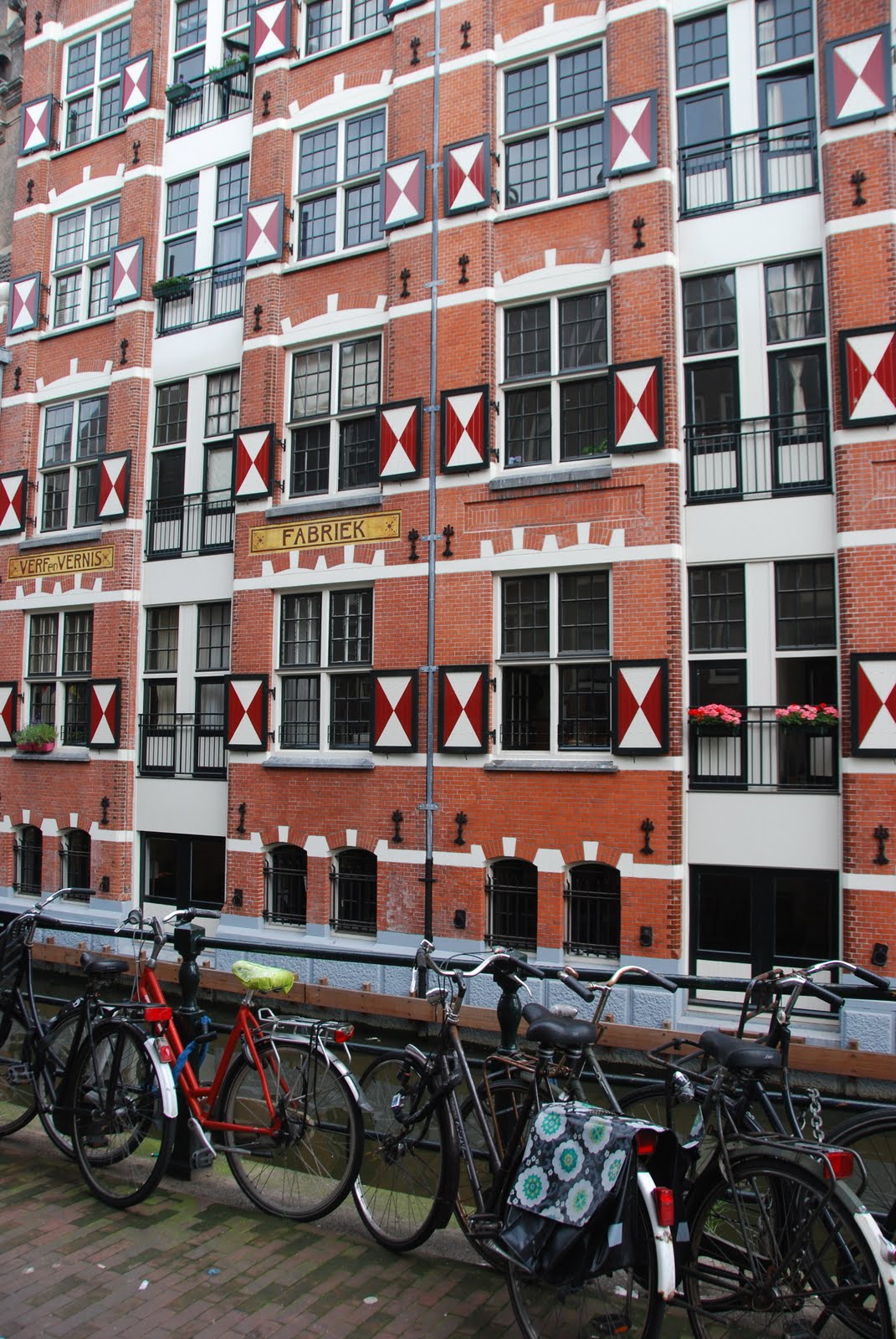
Amsterdam
Amsterdam is one of the most accessible cities. The central area is a living legacy from the seventeenth century golden age when the city was the hub of a vast mercantile empire that stretched across the globe. My cruise started from the very place where once ships arrived laden with spices from the Far East and furs from the North American interior.
The first stop was Rostock, a beautiful Hanseatic League city with many of its medieval churches and most of its walls still intact. Sitting at an outside café table sipping coffee, eating a rich German cake and looking at the people in the market place reminded me again of how much I miss living in a European city. I live in the banality of the US suburbs where accessibility is purchased at the expense of lively public spaces where you can simply sit and watch.

Rostock: old city walls and tower
Stockholm was a bit of a bust. It rained the entire day, sheets of grey rain clouding the city and undermining plans to walk the streets of the old town, Gamla Stan. Spent most of the day at the Museum of Modern Art. The Swedes have that easy embrace of modernity that makes their public spaces so smoothly elegant.
Wandered around the medieval city of Tallinn. With its finely textured urban form and beautifully colored buildings, it is an urbanist’s delight.

Tallinn
A day in Helsinki where I visited the railway station designed by Eliel Saarinen, father of Eero, and wandered around the inner city dominated by gorgeous art noveau buildings. Then a day in Copenhagen–if its Saturday it must be Denmark– where I wandered down the pedestrian streets and visited the National Museum and then the modern extension to the National Library.

Eliel Saarinen's railway station in Helsinki
Flew back to DC and completed the US-Scandinavian modernist encounter and experience by arriving at the terminal designed by Eero Saarinen.
As my memory quickly edits out all the petty annoyances of the trip I only recall the joyful experience of the walkability and sociability of the Northern cities where public space and the civic realm are respected and treasured.
(All Photos © John Rennie Short)
Sunday, May 15, 2011
The next level
“Moving to the next level”. The phrase is pervasive. Used everywhere and all the time. Every organization and individual it seems is being urged to move to the next level. It is even the title of books and companies. The next level is always the one beyond our present level. The unstated assumption is that this level is not satisfactory. It is always the next level wherein lies success and happiness and fulfillment. Where we are now is to be unsuccessful and unfulfilled. Tantalizingly, it is always the level just above us, just beyond us that provides the rewards. And while there is much to admire about this constant striving; remember it is just that, a constant striving. Maybe we need to be concerned with this level. The here and the now. Where we are at this moment in time. Not some distant place or other time in the future. The single-minded obsession with the future fails to appreciate the present. Perhaps we need to attend to this level rather than the one always just beyond our grasp, being rather than becoming.
Subscribe to:
Posts (Atom)
